More screenshots
Works with the AI Agents you already use
 Claude Code
 Cursor
 Codex CLI
 Muse
 Dots+21 moreClaude CodeCursorCodex CLIMuseDots
 Manus
 Grok
 Grok Bot+18 agents
Paper Scout — Real Papers, Citation Map & BibTeX
Finds and maps real, verified research papers using academic APIs to eliminate hallucinated citations.
Free

Paper Scout — Real Papers, Citation Map & BibTeX
Example session with this skill installed
Find the key papers on how galaxy merger histories are reconstructed from stellar data, since 2016. I need a reading list, BibTeX, and a way to see how the papers connect.
- Read your context and instructions
- Compiled the paper scout
Searching for: "galactic archaeology clustering", "stellar streams", "Gaia-Enceladus merger", "chemodynamical tagging" (2016–now) · then snowballing from the top 4 papers.
Found 121 records → 114 after screening → 21 included. OpenAlex returned 112 of the papers and arXiv 41 (with overlap); Semantic Scholar was rate-limited, so the run continued without it. 7 papers were excluded with reasons (e.g. simulation-framework papers, streams around other galaxies).
The literature centres on one event — the
Gaia-Sausage-Enceladus (GSE) merger ~8–11 Gyr ago — studied three ways: halo kinematics, stellar chemistry, and globular-cluster ages. Recent work debates GSE's mass and finds evidence of an even earlier merger.
Reading list (top 12)
| Year | Paper | Venue | Citations | Why read it |
|---|---|---|---|---|
| 2021 | Naidu et al. — Reconstructing the Last Major Merger of the Milky Way with the H3 Surv… | The Astrophysical Journal | 163 | First N-body simulations tailored to GSE; mass and halo fraction |
| 2018 | Helmi et al. — The merger that led to the formation of the Milky Way’s inner stellar … | Nature | 1233 | The discovery paper for Gaia-Enceladus |
| 2018 | Belokurov et al. — Co-formation of the disc and the stellar halo★ | Monthly Notices of the Royal | 1026 | Radial halo anisotropy → one massive accretion 8–11 Gyr ago |
| 2018 | Haywood et al. — In Disguise or Out of Reach: First Clues about In Situ and Accreted St… | The Astrophysical Journal | 359 | Gaia DR2 dual sequence: accreted vs heated disc |
| 2020 | Feuillet et al. — The SkyMapper-Gaia RVS view of the Gaia–Enceladus–Sausage – an investi… | Monthly Notices of the Royal | 118 | How to select clean GSE samples; mass estimate |
| 2020 | Grand et al. — The dual origin of the Galactic thick disc and halo from the gas-rich … | Monthly Notices of the Royal | 126 | Simulations: gas-rich GSE built the thick disc |
| 2020 | Fragkoudi et al. — Chemodynamics of barred galaxies in cosmological simulations: On the M… | Monthly Notices of the Royal | 157 | Counterpoint — argues for a small GSE |
| 2023 | Ciucă et al. — Chasing the impact of the Gaia-Sausage-Enceladus merger on the formati… | Monthly Notices of the Royal | 54 | ML ages for 68k giants show the merger's chemical footprint |
| 2026 | Massari et al. — Evidence of a massive accretion event 1.8 billion years before the Gai… | Nature Astronomy | 3 | Globular-cluster ages reveal an earlier merger |
| 2024 | Ernandes et al. — Gaia-Sausage-Enceladus star formation history as revealed by detailed … | A&A 691, A333 (2024) | 18 | GSE's own star-formation history from abundances |
| 2024 | Deason & Belokurov — Galactic Archaeology with Gaia | New Astronomy Reviews | 78 | Review: Galactic archaeology after Gaia |
| 2024 | Bonaca & Price-Whelan — Stellar streams in the Gaia era | New Astronomy Reviews | 80 | Review: stellar streams in the Gaia era |
Start here
Helmi et al. 2018 — the discovery.
2.
Belokurov et al. 2018 — the kinematic evidence.
3.
Naidu et al. 2021 — the most complete reconstruction. Then read
Fragkoudi et al. 2020 for the opposing view.
Files
papers.json— all 121 records with abstracts, scores and screening notesreferences.bib— BibTeX for the 21 included paperscitation_map.html— interactive map: 114 papers, 447 citation links, 6 clusters, network and timeline views
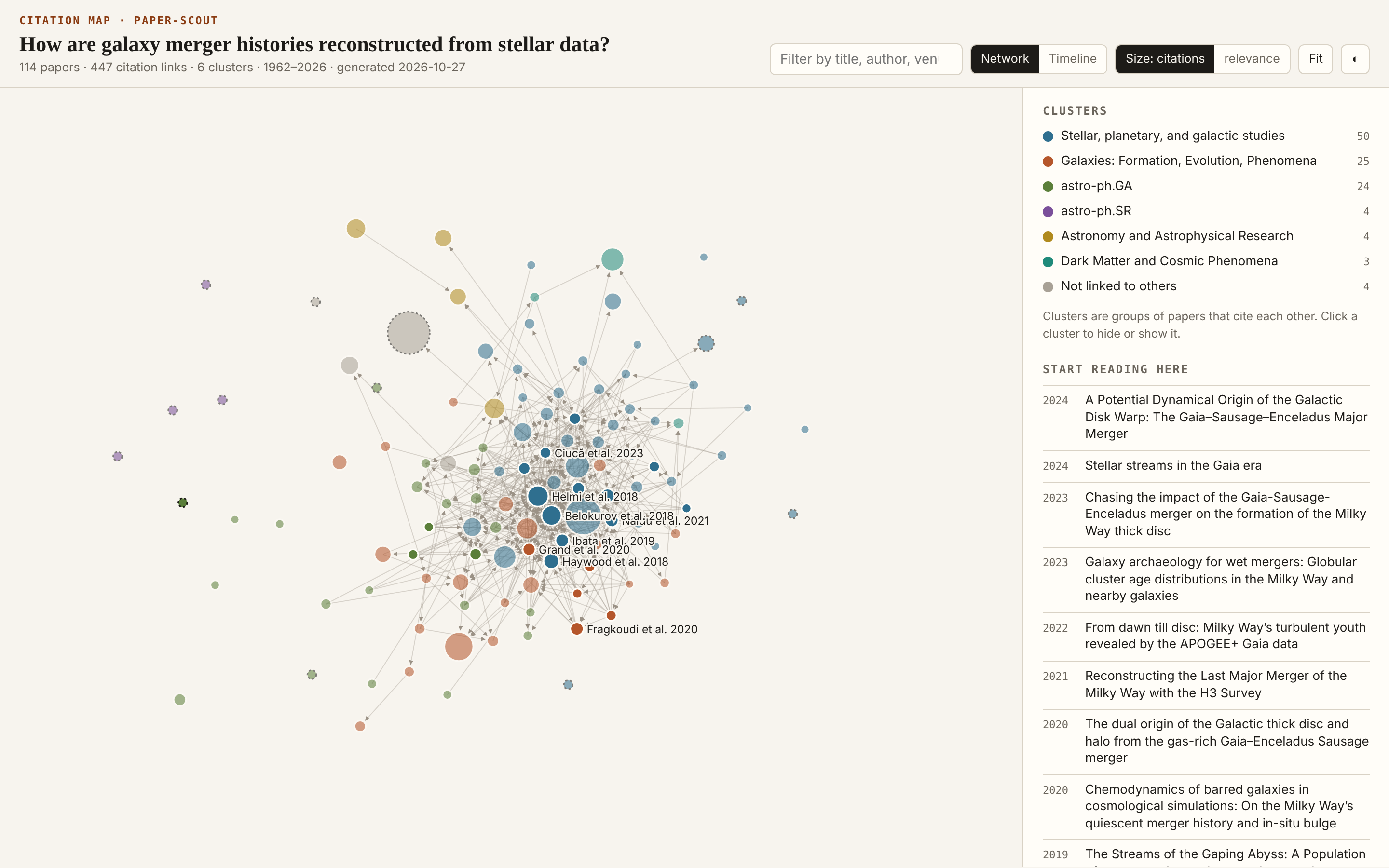
Next step: run Claim Conflict Finder on these 21 papers to see where they disagree.
Connects securely to your tools. The creator never sees your data.
About this skill
Finding reliable research papers is a manual grind prone to hallucination. This skill solves the "fake citation" problem by connecting directly to real-world academic databases to identify, rank, and map peer-reviewed literature without inventing data.
What it does
- Multi-source retrieval queries OpenAlex, Semantic Scholar, and arXiv to find papers across disciplines.
- Paper ranking filters results by relevance and citation count to identify seminal and recent work.
- Reference snowballing follows citation paths forward and backward to find missed papers and context.
- Citation mapping generates an interactive HTML visualization of research clusters and timelines.
- Artifact generation produces clean BibTeX files and JSON datasets compatible with the Research Suite.
How it works
- Search Planning identifies search strings based on your research question and discipline.
- Automated Scout runs a Python-based pipeline to search, rank, and enrich paper metadata.
- Expert Screening reviews abstracts to exclude off-topic results and balance perspectives.
- Export delivers a ranked reading list, a .bib file, and a visual citation map.
Frameworks & tools
This skill utilizes the scripts/scout.py utility which relies on the Python 3 standard library. It interfaces with the OpenAlex, Semantic Scholar, and arXiv APIs for real-time data retrieval.
Why this beats prompting it yourself
Generic AI models frequently hallucinate DOIs and titles, leading to "ghost papers" that do not exist. This skill forces the agent to use verifiable API records, ensuring every citation is real and providing the actual BibTeX for your reference manager.
Use cases
- Start a literature review with a ranked list of 25 validated papers.
- Identify the foundational papers and latest preprints in a new niche.
- Generate a BibTeX library for a specific research question automatically.
- Visualize the development of a specific technology or theory over time.
Known limitations
Coverage is limited to what is indexed by OpenAlex, Semantic Scholar, and arXiv. It may miss non-English work, physical books, or papers with strictly paywalled abstracts.
Limited to OpenAlex, Semantic Scholar, and arXiv coverage. May miss books and non-English papers. API rate limits apply without personal keys.
How to use
- 1
Connect your agent to the Agensi MCP
Copy the prompt and paste it into Claude, ChatGPT, Cursor or any agent that supports MCP. It sets up the connection for you. Manual setup
- 2
Sign in to Agensi
Your agent shows a sign-in link. Sign in and click Allow.
- 3
Ask for what you need
Your agent loads this skill and uses it on your task. It always asks before any payment.
Reviews
No reviews yet
Be one of the first to try it. Every listed skill goes through the trust checks below.
Security scanned
Checked by our 8-point scan before listing
Fresh listing
Recently published to Agensi
Free forever
No account required to browse
Trust & safety
Security scan
Security scan passed 21 days ago
- Free with an Agensi account
Requires
 Openalex
 Semanticscholar
 Arxiv
 Doi
 W3
Permissions
Allowed Hosts