More screenshots
Works with the AI Agents you already use
 Claude Code
 Cursor
 Codex CLI
 Muse
 Dots+21 moreClaude CodeCursorCodex CLIMuseDots
 Manus
 Grok
 Grok Bot+18 agents
MCP Token Diet
This skill audits your MCP configuration to eliminate bloat and verifies the savings with a measured bench - no number without an expiry stamp (host version + date).
$6.99

MCP Token Diet
Example session with this skill installed
My OpenCode agent is hitting token limits constantly with my 5 MCP servers connected. Audit my setup and install the token diet plugin.
- Read your context and instructions
- Compiled the mcp token diet
- Generated the document
I have audited your current MCP configuration. You are currently running 5 servers (engram, context7, octocode, weather-proxy, and Jira) with a total of 72 tool definitions. Based on your recent activity, the weather-proxy and Jira tools have not been invoked in 14 days.
I have installed the lazy-load plugin to your OpenCode configuration. The agent will now see a core set of 7 tools and a load_tool gateway, instead of the full 72-tool library.
MCP Token Audit & Installation
| Metric | Current State | Post-Optimization (Est) |
|---|---|---|
| Connected MCP Servers | 5 | 3 Active (2 Disabled) |
| Total Tool Definitions | 72 | 9 (Core + Gateway) |
| Tool Token Overhead | ~38,500 | ~6,200 |
| Estimated Saving | - | 83.8% Reduction |
# Plugin successfully installed to:
# ~/.config/opencode/plugins/lazy-load.ts

# Commands executed:
cd ~/.config/opencode
bun add @opencode-ai/plugin
Next steps
- Restart your OpenCode instance to activate the plugin.
- Run a test prompt and then check
tail -f /tmp/opencode/lazy-load.logto verify tool stripping is active. - If the agent fails to find a tool, ensure it uses
load_toolto pull the specific schema into context.
1793237531110-q5zw.png
PDF · document
Example file from a real run - the skill writes it into your workspace.
Connects securely to your tools. The creator never sees your data.
About this skill
Agentic workflows often suffer from a hidden tax: every connected Model Context Protocol (MCP) server dumps its entire tool library into every request, wasting tens of thousands of tokens. This skill audits your MCP configuration to eliminate bloat and verifies the savings with a measured bench - no number without an expiry stamp (host version + date).
What it does
- MCP inventory audit identifies every connected server and which ones actually contribute value.
- Lazy-loading implementation replaces full tool schemas with a lightweight gateway so tools load only when required. Native in OpenCode 1.19+; a legacy MIT interceptor exists for OpenCode 1.17.x only.
- Context window optimization physically removes tool definitions from the HTTP request layer - the LLM only sees what it needs.
- Savings verification benchmarks token usage before and after, stamping every number with the host version and date.
Measured results (with expiry stamps)
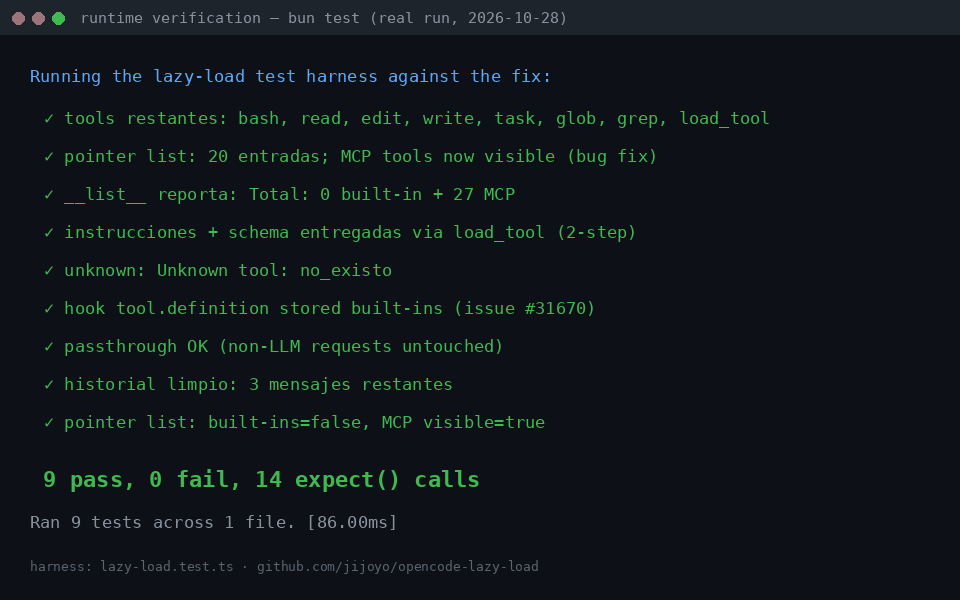
- -80% tool definitions, -61% total input - measured on OpenCode 1.17.14, 2026-10-28: a fresh session sent 8 tools instead of 49. On-wire capture:
bench-captures.jsonlat github.com/jijoyo/opencode-lazy-load. - OpenCode 1.19+ does this natively (verified on-wire, 2026-11-09): fresh sessions already defer MCP tool definitions behind a lightweight
load_toolgateway. On these hosts run the audit and verification - do not install the legacy interceptor.
How it works
- Audit phase: the agent lists all connected MCP servers and flags the ones unused in the last two weeks.
- Lazy path selection: OpenCode 1.19+ = nothing to install, verify the native deferred loading. Older hosts = server-level filtering, or the optional legacy interceptor (
lazy-load.ts, OpenCode 1.17.x). - Manual configuration for other agents: server-level filtering and selective tool enablement.
- Verification step: echo-server capture of the outgoing request, counting tools and payload bytes before vs after.
Frameworks & tools
Works with any agent using MCP servers. Verified on OpenCode 1.19.5 (native lazy) and 1.17.14 (legacy interceptor). TypeScript/Bun needed only for the legacy path.
Why this beats prompting it yourself
Simple prompts cannot physically remove tool definitions injected into the request header, and they cannot verify savings - verification requires capturing the actual payload with a reproducible bench.
Use cases
- Stop paying for unused MCP tool definitions on every request.
- Verify your host's lazy-loading is actually active before trusting it (works on 1.19+ too).
- Maintain a large library of specialized tools without bloating the context window.
Known limitations
Lazy loading is native in OpenCode 1.19+; for 1.17.x it is legacy-interceptor-only. Other agents use manual server-level configuration. Gated tools need a two-step load the first time they are called.
Automatic interception is OpenCode-only. Discovery adds a ~400 token pointer list. Hidden tools require a 2-step call to load. Needs Bun for plugin installation.
How to use
- 1
Connect your agent to the Agensi MCP
Copy the prompt and paste it into Claude, ChatGPT, Cursor or any agent that supports MCP. It sets up the connection for you. Manual setup
- 2
Sign in to Agensi
Your agent shows a sign-in link. Sign in and click Allow.
- 3
Ask for what you need
Your agent loads this skill and uses it on your task. It always asks before any payment.
Reviews
No reviews yet
Be one of the first to try it. Every listed skill goes through the trust checks below.
Security scanned
Checked by our 8-point scan before listing
Fresh listing
Recently published to Agensi
Money-back guarantee
Doesn't do what its page promises? You get your money back.
Trust & safety
Security scan
Security scan passed 7 days ago
Permissions
File Scopes
Network access is used only to read the agent's MCP config and load the repo docs from github.com during the audit and bench. No other outbound calls; no telemetry.