More screenshots
Works with the AI Agents you already use
 Claude Code
 Cursor
 Codex CLI
 Muse
 Dots+21 moreClaude CodeCursorCodex CLIMuseDots
 Manus
 Grok
 Grok Bot+18 agents
LinkedIn OS: 28-Skill Content System
Build the brand files, validate ideas, write and score posts, design on-brand carousels, and gate every post before it goes live.
$99

LinkedIn OS: 28-Skill Content System
Example session with this skill installed
I post about B2B SaaS onboarding. Here are five posts I liked writing. Build my brand files, then give me six ideas for next month, with one draft I can publish on Thursday.
- Read your context and instructions
- Compiled the linkedin os
Brand gate
Wrote docs/brand/brand.md, audience.md, about-me.md, voice.md, and story-bank.md. Voice check passed 4/4. Every pillar has at least one proof artifact.
Plan, next six posts
| # | Day | Type | Idea | Pillar | Score |
|---|---|---|---|---|---|
| 1 | Tue | Proof | onboarding 11 days to 3 | 2 | 27 |
| 2 | Thu | Contrarian | your process is the product | 1 | 25 |
| 3 | Mon | Story | the Friday cancellation | 2 | 24 |
Thursday draft
Three variants, 940 to 1,020 characters. Recommended variant B. The style checker passes with 0 errors. The publish gate is blocked on one claim: the 11-day baseline needs the source screenshot before it can go live.
Confirmation gate: I have prepared the brand files and the plan. One claim is unsourced. Do you confirm the plan and want me to wait for the screenshot?
Connects securely to your tools. The creator never sees your data.
About this skill
LinkedIn OS
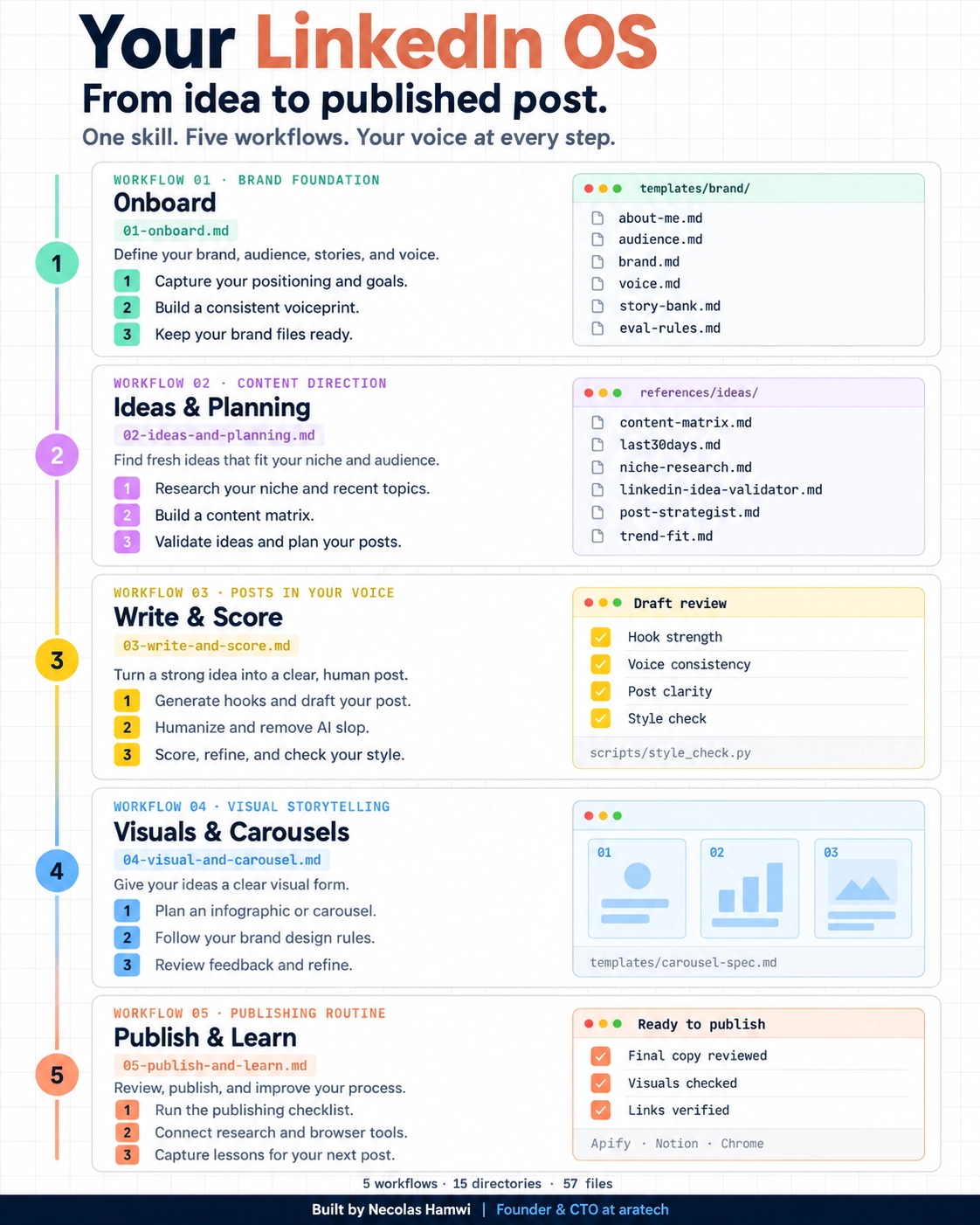
LinkedIn OS is a complete content system for people who publish to build a business, not to chase impressions. It replaces the usual pile of prompt templates with a small set of brand files that every playbook reads, a gate that stops work when those files are missing, and 28 playbooks that each do one job.
Most AI-written LinkedIn content fails for two reasons. It sounds like a model, and it should never have been written. This system attacks both. The idea validator kills weak ideas before anyone drafts them. The voice builder measures how the user actually writes, from real samples, instead of describing them with adjectives. The de-slop pass removes the mechanical tells that survive editing: invisible characters, em dashes, filler vocabulary, reveal bridges, and the staccato run that every AI writing guide taught every model.
The five jobs
Setup. An onboarding interview writes five files: brand, audience, about-me, voice, and story bank. Every other playbook reads them first. Nothing runs without them.
Voice and profile. Measure sentence length, openers, closers, punctuation, pronouns, and signature phrases from real posts. Rebuild the headline, about section, banner, and featured section with a 12-item, 100-point rubric. Read the analytics export and turn it into rules.
Ideas. Generate 32 or more ideas in a matrix, find 20 concrete stories in the niche, build a quote bank from the last 30 days, score trends against the user's own proof, and kill weak ideas on six axes.
Writing. Produce hooks from 21 named formulas, draft three variants in the user's voice, score on seven dimensions with an asymmetric weighting, and run the mechanical sweep.
Visuals. Build a carousel or quote card as one self-contained HTML file, polish it against a fixed checklist, remove the visual tells of AI design, and save the critique as reusable rules.
Publishing. Run a seven-part gate before anything goes live: mechanical, claims, structure, close, voice, repetition, assets. Then feed the result back into the next plan.
What makes it different
- The brand gate. The system refuses to write before the context files exist. That one rule is why the output sounds like a person.
- Measured voice. The voice file contains numbers and quoted evidence, not adjectives.
- Asymmetric scoring. The verdict is
mean x 0.6 + weakest x 0.4. A weak hook cannot hide behind six strong dimensions. - Named formulas with traps. Every hook pattern includes its failure mode.
- A real gate.
publish-checkblocks a post and lists the fixes. It does not congratulate. - Deterministic checks. An offline script checks the mechanical house rules and exits non-zero on failure.
- Provenance. The rubrics were cross-checked against public MIT repositories. The evidence and the settled design decisions ship with the skill.
What is included
- 28 playbooks grouped into five jobs, plus this router.
- 5 numbered workflows, one per job.
- 7 brand-file templates and 6 output templates.
- An offline
style_check.pywith 16 unit tests. - A worked carousel draft and a filled brand file as examples.
- The provenance and cross-check log.
Who it is for
Founders, consultants, operators, and creators who publish their own thinking and want a repeatable system instead of a content calendar full of generic advice. It works for one person or a small team. It is not a scheduling tool and it does not publish for you.
Honest limitations
- It is a writing and design system, not a guarantee of reach or revenue.
- The Apify, Notion, and browser modules need a user-connected account. Without one they degrade to a manual paste.
- The skill never handles credentials and never publishes.
- LinkedIn limits and formats change. The numbers were verified on 2026-10-30.
- English first. Other languages need their own voice measurement.
A writing and design system, not a guarantee of reach or revenue. The Apify, Notion, and browser modules need a user-connected account and degrade to a manual paste without one. No automatic publishing, scheduling, or scraping. LinkedIn limits and formats were verified on 2026-10-30 and will change. English first; other languages need their own voice measurement. The skill never handles credentials.
How to use
- 1
Connect your agent to the Agensi MCP
Copy the prompt and paste it into Claude, ChatGPT, Cursor or any agent that supports MCP. It sets up the connection for you. Manual setup
- 2
Sign in to Agensi
Your agent shows a sign-in link. Sign in and click Allow.
- 3
Ask for what you need
Your agent loads this skill and uses it on your task. It always asks before any payment.
Reviews
No reviews yet
Be one of the first to try it. Every listed skill goes through the trust checks below.
Security scanned
Checked by our 8-point scan before listing
Fresh listing
Recently published to Agensi
Money-back guarantee
Doesn't do what its page promises? You get your money back.
Trust & safety
Security scan
Security scan passed 15 days ago
Permissions
File Scopes
Reads user-provided posts, brand files, analytics exports, notes, and graphics sources; writes drafts, plans, reports, and HTML graphic sources to the working directory. The bundled script runs locally with the Python standard library. The skill does not call the network, read environment variables, handle credentials, or publish. Optional tools modules use an account the user connects in their own agent.