More screenshots
Works with the AI Agents you already use
 Claude Code
 Cursor
 Codex CLI
 Muse
 Dots+21 moreClaude CodeCursorCodex CLIMuseDots
 Manus
 Grok
 Grok Bot+18 agents
Claim Conflict Finder — Where Papers Disagree, and Why
Extracts structured claims from research papers to identify, categorize, and explain contradictions in the literature.
Free

Claim Conflict Finder — Where Papers Disagree, and Why
Example session with this skill installed
Using the papers in research/milky-way-mergers, where do they disagree about the Gaia-Sausage-Enceladus merger — and is it real disagreement or just different methods?
- Read your context and instructions
- Compiled the claim conflict finder
- Generated the document
Extracted 21 claims from 15 papers (each with a verbatim quote, checked against the abstract) and compared every pair.
Bottom line: the papers agree GSE was
gas-rich and that it
built the stellar halo and thick disc. They disagree on
how massive it was and
how long it formed stars — but every disagreement found is explained by different data or methods, so
0 are genuine conflicts (same setup, opposite answer).
Relationships studied by 2+ papers
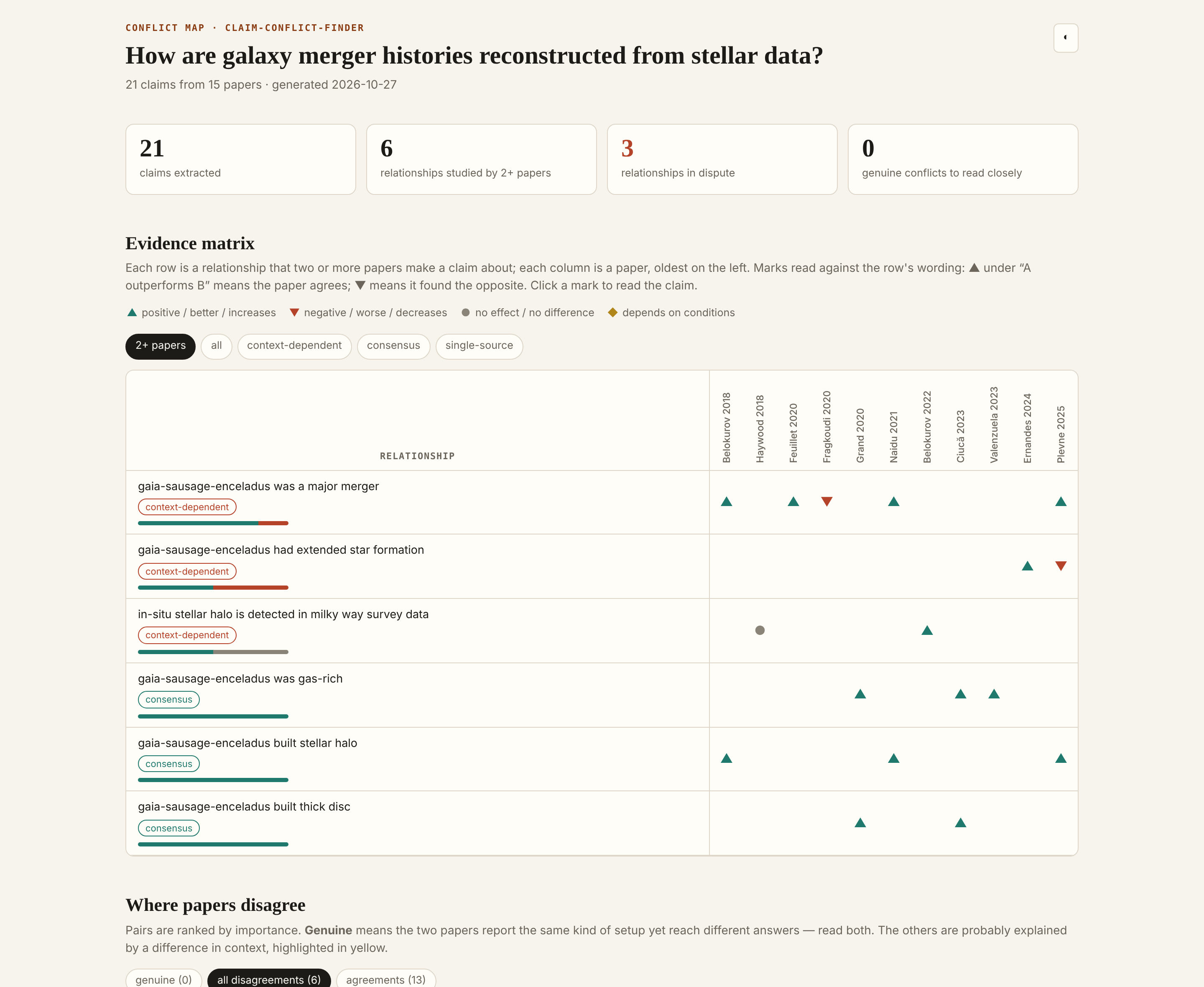
| Relationship | Verdict | Papers | Evidence |
|---|---|---|---|
| gaia-sausage-enceladus was a major merger | context-dependent | 5 | 4 ▲ · 1 ▼ · 0 ● |
| gaia-sausage-enceladus had extended star formation | context-dependent | 2 | 1 ▲ · 1 ▼ · 0 ● |
| in-situ stellar halo is detected in milky way survey data | context-dependent | 2 | 1 ▲ · 0 ▼ · 1 ● |
| gaia-sausage-enceladus was gas-rich | consensus | 3 | 3 ▲ · 0 ▼ · 0 ● |
| gaia-sausage-enceladus built stellar halo | consensus | 3 | 3 ▲ · 0 ▼ · 0 ● |
| gaia-sausage-enceladus built thick disc | consensus | 2 | 2 ▲ · 0 ▼ · 0 ● |
The main debate: was GSE a major merger?
Belokurov et al. (2018): The inner-halo debris came from a single massive satellite (virial mass above 10^10 solar masses) 8–11 Gyr ago.
"a satellite with Mvir > 1010M⊙ around the epoch of the Galactic disc formation"
vs Fragkoudi et al. (2020): Auriga galaxies matching the Milky Way bulge allow GSE a mass ratio of only a few per cent, i.e. a quiet merger history.
"suggesting an upper limit of a few per cent for the mass ratio of the recently proposed Gaia Sausage/Enceladus merger"
Why they may differ: Belokurov et al. (2018) and Fragkoudi et al. (2020) reach opposite conclusions. Likely explained by different datasets, different populations / settings, different methods or study designs.
Four observational studies say yes (halo debris, stellar mass 10^8.85–9.85 M⊙); one simulation study matched to the bulge allows only a few-per-cent mass ratio. They measure different things — that's the real source of the conflict.
A debate that more data resolved
Haywood et al. (2018): Gaia DR2 halo stars split into accreted stars and heated old disc; no in-situ halo population is robustly identified.
"the in situ stellar halo of the Galaxy may in fact be fossil records of its last significant merger"
vs Belokurov & Kravtsov (2022): Aluminium abundances isolate a metal-poor in-situ component, 'Aurora', born before the disc spun up.
"The low-metallicity ([Fe/H] ≲ −1.3) in-situ component we dub Aurora is kinematically hot"
Why they may differ: Belokurov & Kravtsov (2022) finds an effect; Haywood et al. (2018) finds no significant effect. Likely explained by different datasets, different methods or study designs.
Files
conflict_map.html— evidence matrix + side-by-side conflict cardsconflicts.md— this report, all 6 disagreeing pairs rankedclaims.json— 21 structured claims ·claims.ttl— RDF knowledge graph for SPARQL
Caveat: claims came from abstracts only, so confidence is capped at medium — check the quotes in the full papers before citing.
Next step: run Research Dossier to turn this into a written review.
conflict_map.html
PDF · document
Example file from a real run - the skill writes it into your workspace.
Connects securely to your tools. The creator never sees your data.
About this skill
Research papers often look like they disagree, but usually, they just studied different things. This skill helps you find where the literature actually contradicts itself versus where results differ due to specific conditions. It extracts structured findings from a reading list and maps the landscape of a debate.
What it does
- Extract structured findings from PDFs, DOIs, or titles into a normalized JSON schema.
- Identify conflict types such as direct contradictions, null-versus-effect results, and magnitude disagreements.
- Explain discrepancies by comparing populations, datasets, methods, and metrics across studies.
- Generate evidence matrices including an interactive HTML map and an RDF/Turtle knowledge graph for SPARQL tools.
- Prioritize genuine conflicts by filtering out differences caused by methodology or study design.
How it works
- Ingest papers from a
papers.jsonfile or user-provided identifiers, prioritizing full-text over abstracts. - Extract claims using a strict schema that records subjects, objects, relations, and verbatim evidence quotes.
- Run analysis scripts to calculate conflict severity and generate the interactive evidence matrix.
- Refine findings by manually checking high-severity conflicts for hidden variables like follow-up length or baseline controls.
Frameworks & tools
Uses standard-library Python for analysis and generates RDF/Turtle, JSON, and self-contained HTML.
Why this beats prompting it yourself
Generic prompts miss the nuance of "hidden" variables like sample size or metric definitions that explain away apparent contradictions. This skill enforces a strict evidence-extraction schema and uses a logic-based script to ensure every reported conflict is backed by verbatim quotes and consistent terminology.
Use cases
- Map the debate within a specific research field for a literature review.
- Audit a set of papers to find outliers or results that fail to replicate.
- Prepare a research dossier by identifying exactly what future studies need to settle.
- Build a structured knowledge graph of claims from a reading list.
Known limitations
Extraction can be slow for more than 25 papers at once. Claims based only on abstracts are capped at medium confidence. Requires standardized naming for concept alignment.
Limited to 25 papers per batch for extraction speed. Claims from abstracts are marked medium confidence. Requires Python for HTML/TTL generation. Concepts must be normalized via aliases.
How to use
- 1
Connect your agent to the Agensi MCP
Copy the prompt and paste it into Claude, ChatGPT, Cursor or any agent that supports MCP. It sets up the connection for you. Manual setup
- 2
Sign in to Agensi
Your agent shows a sign-in link. Sign in and click Allow.
- 3
Ask for what you need
Your agent loads this skill and uses it on your task. It always asks before any payment.
Reviews
No reviews yet
Be one of the first to try it. Every listed skill goes through the trust checks below.
Security scanned
Checked by our 8-point scan before listing
Fresh listing
Recently published to Agensi
Free forever
No account required to browse
Trust & safety
Security scan
Security scan passed 21 days ago
- Free with an Agensi account
Requires
 Python